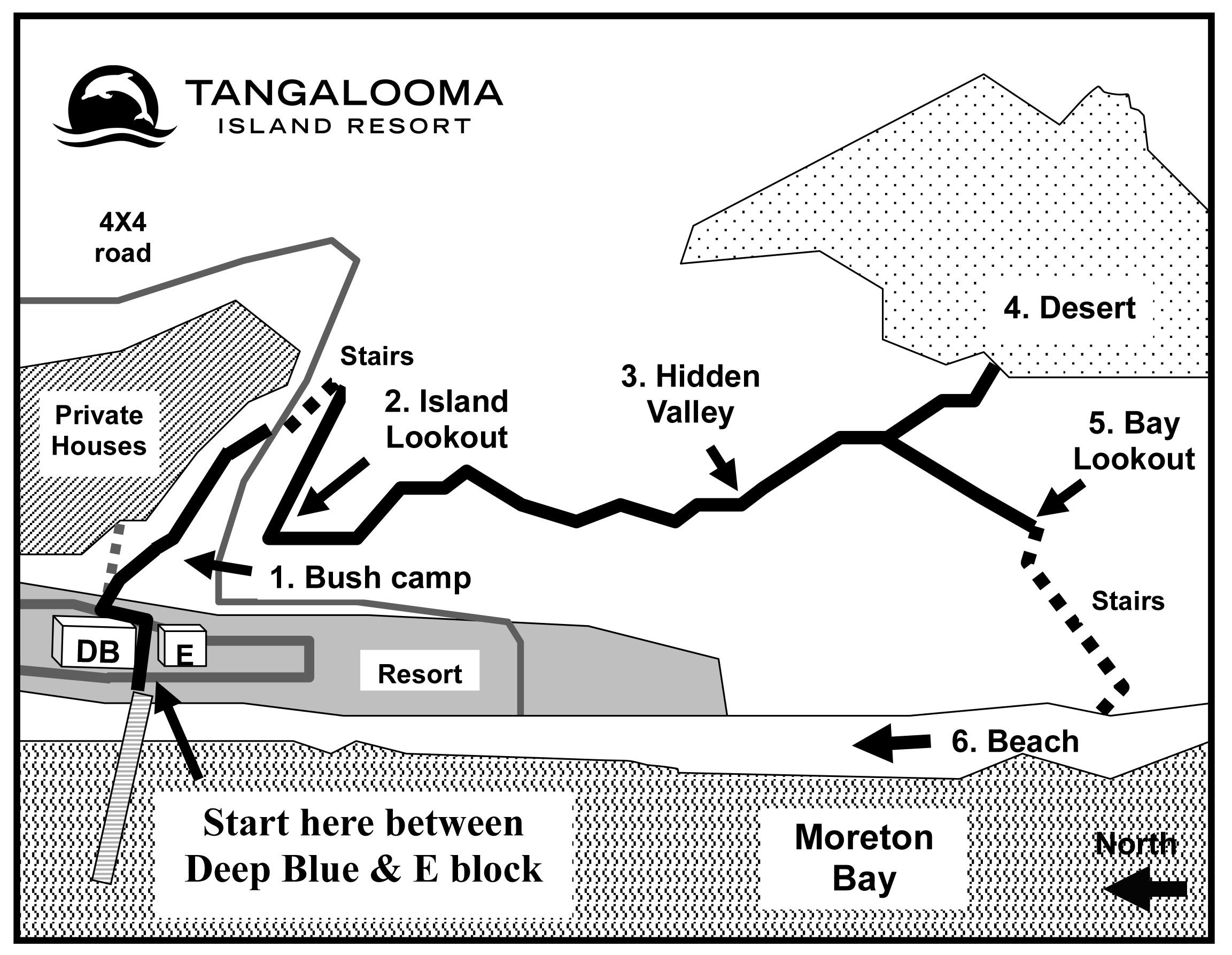
MORETON ISLAND NATIONAL PARK EXPLORER WALK
A self-guided tour through Moreton Island National Park
Easy to Medium Difficulty
Track Distance: 3.5-4km
Estimated Time: 1½-2hrs
See the Eco Centre for more information
STOP 1-Bush Camp
The aboriginal people that used to live on Moreton Island were called the Ngugi tribe. They relied on vast knowledge of plants and animals that could be used for food, medicines, shelter, tools and clothing.
Aboriginal Housing
The Ngugi tribe would have set up temporary shelters as they moved about the island. They would have used material from the Australian bush including Livastonia leaves and Sheoak for thatching, Paperbark for bedding, and Lomandra leaves for roping.
Midden
Archaeological sites (Middens) were discovered through-out the island dating back to at least 1,500 years ago!
The Middens contained discards of fish, shellfish and du-gong and turtle bones. The Ngugi tribe had a marine-based lifestyle supplemented by plant foods, also known as Bush Tucker. Some of the important bush tucker on Moreton Island includes Bungwall fern, Midyim berries, Melaleuca tea tree flowers and Blue Flax Lily.
STOP 2-Moreton Island Lookout
From the lookout you can see the geomorphology of Moreton Island and its vast diversity of bush land.
Moreton Island
The aboriginal name for Moreton Island is Moorgumpin-meaning “place of many sand hills” Moreton Island is the third largest sand island in the world! It is 98% sand and 2% rock.
Can you spot Mount Tempest?
If you look to the North, you will see Mount Tempest, the largest vegetated sand dune in the world! Standing at 280m!
The only rock found on the island is at Cape Moreton at the northern point of the island. Over millions of years, sands and sediments from the river systems of NSW built up behind the rocky outcrop, forming Moreton Island.
National Park
Moreton is 98% national park (2% private land) and is home to many species of animals! There is…
-
195 native bird species
-
14 native mammals-such as possums, gliders & bandicoots
-
36 reptiles- snakes, lizards & fresh-water tortoises
-
11 frogs
STOP 3-Hidden Valley
Can you spot the Kookaburra nest??
When in the valley keep your eyes peeled for a dirt mound in the trees, with a hole on the side! Flora is very important for Moreton Island as it stabilizes the sediments and maintains the structure of the sand hills. The vegetation on the island is very typical of Australian bush, being quite hardy and able to withstand the harsh environment such as sand, salt and little nutrients. These include gum trees, paperbark trees, cotton trees, banksias, grass tress, sheoaks, wattles, pandanus etc.
All the flora on the island rely on the extensive ground water system. The water table covers 156km², 200m deep, and is only 2m below the surface. This ground water system has formed some freshwater lagoons/lakes on the island. The Hidden Valley has a lot more moisture and nutrient content in the soil from rainwater runoff and the water table being closer to the surface of the top-soil. These valleys can be found all throughout the national park.
Did you spot the kookaburras nest?
Kookaburras on the island like to use termites nests as their own nests! They use it because its nice and warm so the eggs stay incubated and there is food for when the eggs hatch.
STOP 4 -Desert
Moreton Island’s mineral sands originated from the highlands of NSW and were carried by rivers to sea and deposited onto Cape Moreton.
There are many theories as to why the Desert has few plant life when it is surrounded by full vegetation, but there is no scientific explanation, making it a unique place!
The large dunes in the Desert are shaped from the strong winds and are always changing. They now stand at over 60m!
STOP 5-Moreton Bay Lookout
Moreton Bay Marine Park covers 3400km2 and extends from Caloundra in the north almost down to Surfers Paradise in the south.
The bay is quite shallow (~20m average depth), allowing for many habitats to form, including seagrass, mangrove, saltmarsh and coral.
With such habitats, comes a large abundance of marine life!
Some of the marine life includes 600 Inshore Bottlenose Dolphins, 800 Dugongs, 10,000 Green Sea Turtles, 2,000 Loggerhead turtles, several stingray species and around 1,100 species of fish!
Threats
The Marine Park and its marine life are still under many human threats including;
-
Pollution– around 100,00 marine mammals like dolphins, turtles and whales die each year from eating plastics or getting entangled in rubbish.
-
Habitat loss- events like land run-off, dredging, anchoring and climate change are reducing habitats which also include food sources for marine life.
-
Overfishing– fish populations around the world are rapidly declining from the increase in demand for fish as the worlds human population increases
-
Fishing Line Entanglements- Discarded hooks and fishing line are very dangerous to the marine life as it can strangle and/or cut animals
STOP 6-Beach
On the beach you will see dune plants like Spinifex, Pigsface and Goats foot vine. These plants are very important for the beach and the island as they stabilize the structure of the dune, without them the beach would erode.
If you look out to the sea you can see the sea grass in the bay which the dugongs and turtles like to eat. While on the beach, keep your eyes peeled for Starfish, Sand Bubbler crab and Ghost crab holes.